
Cybersecurity is one of the most important spaces today in the digital-first economy we live in, and companies across the spectrum are dumping money into securing their data and systems. This has obviously been good news for all the cybersecurity graduates, but it also means that the hiring managers are getting pickier about who they hire. Businesses are not seeking workers who can manage firewalls or hack into a scanner; they are looking for talented professionals who can use techniques and skills in creative ways to solve problems.
Today, many graduates gain exposure to these skills through hands-on projects, cooperatives and even online cybersecurity classes to develop a deeper appreciation. But for a topic like cybersecurity, a few days of learning can be rough. Hence, students get thoughts like, Can I ask somebody to do my online class and help me understand topics better. In this blog, we will dissect a list of top qualities that employers are looking for in cybersecurity graduates.
Core Technical Skills Managers Need in Cybersecurity Graduates
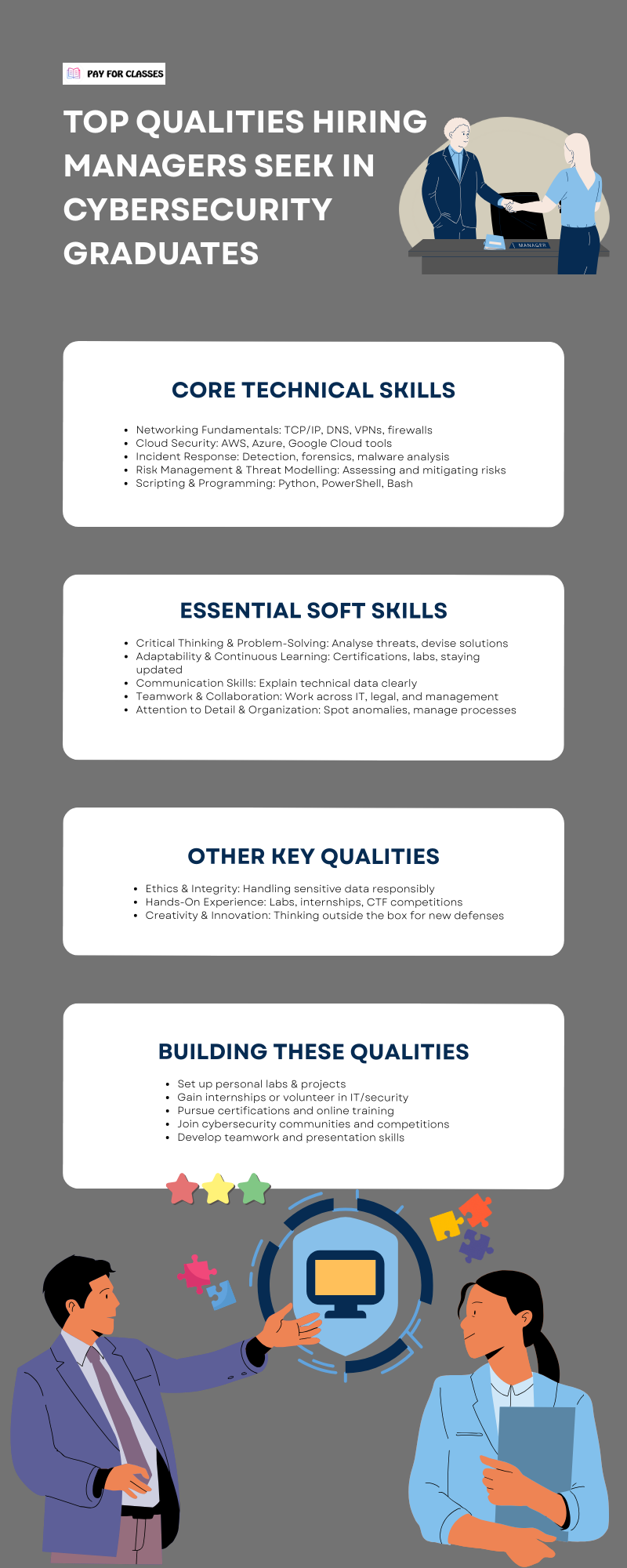
For any cybersecurity professional, technical skill is the basis of their career. Soft skills and fungibility top the list, but hiring managers also want graduates to have a strong footing in key technical areas that form the backbone of contemporary security. These competencies not only prove a cybersecurity graduate to be knowledgeable, but also that they can handle real-world issues in the protection of systems and information.
Networking fundamentals
A strong foundation in networking concepts is usually the first thing that an employer grades you on. Understanding of TCP/IP, DNS, VPNs, routing and network design is key in exploiting weaknesses and architecting secure networks. So often, cyberattacks take advantage of the vulnerabilities of networks. So, those who understand the flow of data from one system to another are better able to help create defences and respond effectively when they fail.
Cloud security
Cloud security has become a mandatory requirement as more workloads are moved to AWS, Microsoft Azure, and Google Cloud. Recruiters like to see experience with cloud-native security tools, identity management and shared responsibility models. Cybersecurity graduates with practical experience can set up secure cloud environments that can rank highly.
Incident response and forensics
IT pros who can find, isolate, and clean up breaches quickly are highly valued by employers. The ability to respond to incidents, analyse malware and digital forensics demonstrates the ability to cope with high-pressure situations. The ability to research logs, identify root cause and prevent its recurrence is an important quality in any cybersecurity hire.
Risk management and threat modelling
Cybersecurity graduates need to expect threats before they are even made. Comprehension of various risk management methodologies and the use of threat modelling techniques assist the graduates in analysing the weaknesses and enacting preventive controls. Recruiters value candidates who can turn risks into practical security approaches that fit into a business strategy.
Scripting and programming
Not every role calls for expert coding, but familiarity with something like Python, PowerShell, or Bash gives cybersecurity graduates a powerful leg up. Coding skills let professionals automate tasks, whether for penetration testing or for deeper systems analysis. On top of this, students will sometimes search for that little bit of extra credit, or even enrol in an online computer science class, to teach themselves more coding and automation to enhance their cybersecurity expertise. Employers view this effort as evidence of adaptability and continual growth. However, how I can do my online computer science class without any hurdles is often a doubt for students who face difficulty with the subject. Moreover, when supplemented by realistic projects and applied labs, graduates prove to employers that they are not only book smart but also ready to apply solutions to real problems.
Also read: Finance and Economics Degrees: Key Differences Explained
Essential Soft Skills Required in Cybersecurity Graduates
Soft skills often dictate whether a cybersecurity graduate is capable of thriving as a professional. Employers are recognising that cyber is not just about setting and responding, it is about strategic thinking, teamwork and flexible engagement with evolving challenges. Hence, employers are interested in hiring the kind of graduates who not only have technical skills but also the human skills that enable them to work well in teams and solve complex problems.
Critical thinking and problem solving
Any security job requires the ability to understand complex situations, identify the cracks and then fix them under pressure. Whether it is finding network intrusion or ideating ways to close a security hole, thinking critically is a requirement. Non-technical learning experiences, like having mathematical knowledge, can help them with better logical reasoning. Moreover, it helps in developing an analytic mindset necessary for discovering patterns and overcoming tricky security problems. However, learning math gets complex for students sometimes. As a result, they have to deal with their thoughts, like, What should I do to take my online math class effectively. While you are in such a situation, you can also search for online class help, and you will be better able to focus without the added stress.
Adaptability and continuous learning
Cybersecurity is evolving constantly. It seems like each day there is a new malware variant, a new ransomware modus operandi, a new attack vector and so on. Hence, managers want graduates who are long-term learners. Cybersecurity graduates with adaptability can change direction when new tools or regulations come into play without those distractions posing threats to the value they offer.
Communication skills
Communication is key in cybersecurity. Hence, the professional should be able explain it to the chief executive, report to a compliance team or communicate to developers. Employers want graduates who can take complicated information and translate it into plain language that everyone involved can understand.
Teamwork and collaboration
Cybersecurity demands that IT, legal, compliance, and the business work together. Hence, cybersecurity graduates generally make better defences and a smoother incident response.
Attention to detail and organisation
Cloudflare alerts are born when one entry gets buried among millions in logs. Moreover, ensuring one misconfiguration is discovered can be the difference between an attack being prevented and not. This means that employers value well-detailed graduates, who look at his or her work systematically.
When you add soft skills to a strong technical education, you do not just get protectors of systems; you produce professionals who easily adapt to a constantly evolving corporate culture.
Also read: Top Academic Websites Every Student Should Know
Other Key Qualities Employers Value in Cybersecurity Graduates
Aside from technical ability and soft skills, other characteristics hiring managers value when it comes to deciding which cybersecurity graduates to bring on board.
Ethics and integrity
Cybersecurity experts deal with very sensitive information, ranging from individuals’ personal data to really important business assets. Employers look for graduates who are ethical and know how to make responsible choices. A moral compass is essential to keep the trust, which is an absolute necessity in this business.
Hands-on experience
Employers will always prefer hands-on experience over theory. Whether through internships, personal labs, or CTF competitions, the fact that graduates can demonstrate they can use what they have learned in application is often a differentiator. Even students with jobs and other responsibilities, for example, someone enrolled in an online algebra class, get creative with opportunities that give them practical experience that are attractive to employers. You can find services to support your academic requirements so that you can focus on getting practical experiences. All you need to do is find a reliable service for your requirements, like, How can I pay someone to take my online algebra class for me.
Creativity and innovation
While the practice of cybersecurity follows a logical structure, the best of the best usually colour outside the lines. Employers want graduates who are ahead of their time when it comes to predicting those risks and taking innovative angles for addressing them. Street smarts like that are a definite plus in pen testing and red teaming because that’s how you find those secondary vectors everyone else missed.
How Cybersecurity Graduates Can Build These Qualities
The skills that job makers seek demand a concentrated focus beyond the classroom.
- Graduates may begin by integrating theory and practice. You can work on open-source security projects or play in CTFs that help you bridge theory with application.
- Internships and part-time work in IT and security-related areas also offer a further opportunity to gain insight into the challenges of the real-world industry.
- Continuous learning is equally important. You will need to continue to develop in the area for example by taking certifications or attending webinars and keeping updated through threat reports.
- A professional network or local cybersecurity group is one opportunity for you to network with others interested in the same type of work and you can also try to bounce ideas off one another.
- Soft skills such as communication and teamwork that are essential for researchers can be developed through group projects, research presentations or mentoring fellow students.
With a combination of technical and soft skills, the cybersecurity graduates have the profile that the companies expect to see in the future employees.
Conclusion
Hiring managers desire cybersecurity graduates with a technical degree, soft skills, hands on practical experiences, and ethical decisions. Graduates with fundamentals of networking, AWS cloud security, and critical thinking and problem-solving skills will be able to resolve complex problems and collaborate on diverse teams.
Frequently Asked Questions
Question:What skills are employers looking for when they hire cybersecurity graduates?
Answer: Employers want skills such as networking basics, cloud security, risk management, scripting and programming. Working directly with tools and platforms adds value to cybersecurity graduates.
Question: What are soft skills for cybersecurity professionals?
Answer: One must have soft skills, including critical thinking, collaboration, communication, building the right teams and the ability to work well together to solve complex problems and adapt quickly to new threats.
Question: What do employers look for when hiring for cybersecurity?
Answer: More than technical expertise, integrity, creativity, a love of learning, and attention to detail can help distinguish graduates and prove that they can scale up to address real-world challenges.