

Today’s education has made the role of internships in academics not only a placeholder but a necessity. It is a link between classroom study and application. Students not only get an exposure to the industry but also learn things which the textbooks cannot provide them with. As education moves toward more flexible formats like online classes, it’s common for students to do internships while also attending class to make the most of their time. These services also assist students with inquiries like: can an expert help me do my online class, and give them time to maintain themselves in other curricular areas. The mix of academic reinforcement and hands-on experience is one example of how internships are an essential bridge to a student’s career.
Understanding Internships in an Academic Context
Internships are formal on-the-job training opportunities in which you apply classroom learning in work settings. They are not just projects or homework but real opportunities for learners to see actual industry practices and learn what it’s like inside the workplace. These are paid or unpaid internships as both on-site and virtual trials (remote), based on the subject matter and discussions. For example, a computer science major can work with a software company, and an education major might work with a classroom.
Moreover, trying to juggle internships with school work, especially for subjects like math, in which one must practice regularly in order to succeed, can be pretty difficult. As a result, when students get frustrated, they usually want to get help and reach out to professionals with a request as, I want someone to take my online maths class for me. It ensures that they are on par with their coursework while giving priority to their practical experiences. Also, it allows them to keep in control of their academic advancement, as well as their internships, without sacrificing any of it.
Bridging Theory and Practice
The primary role of internships in academics is that they provide a practical experience to the theory you have learnt. The lectures and the texts provide the foundation, but it is internships when these students are forced to problem-solve, innovate and drive solutions in ways that cannot be replicated in a classroom. If you are studying marketing, you might know all the theories of marketing, but when you work in a live campaign, you understand better what drives the taste of consumers, and how the market moves up and down. This integration of theory and practice is more than just practical knowledge; it consolidates learning from academic study.
At the same time, many students try to manage internship schedules on top of demanding class schedules. For example, a student majoring in computer science with an internship at a tech company could opt to spend a day coding or working on software development instead of taking their online lectures. However, flexible support services provide these students with solutions to their questions, such as how to do my online computer science class effectively. With these services, students can manage university requirements and focus on their careers at the same time. It’s the optimal mix between theory and practical training for students who want to make sure they are well-prepared for their future.
Also read: How Online Classes Work: Essentials to Know
Skill Development Through Internships
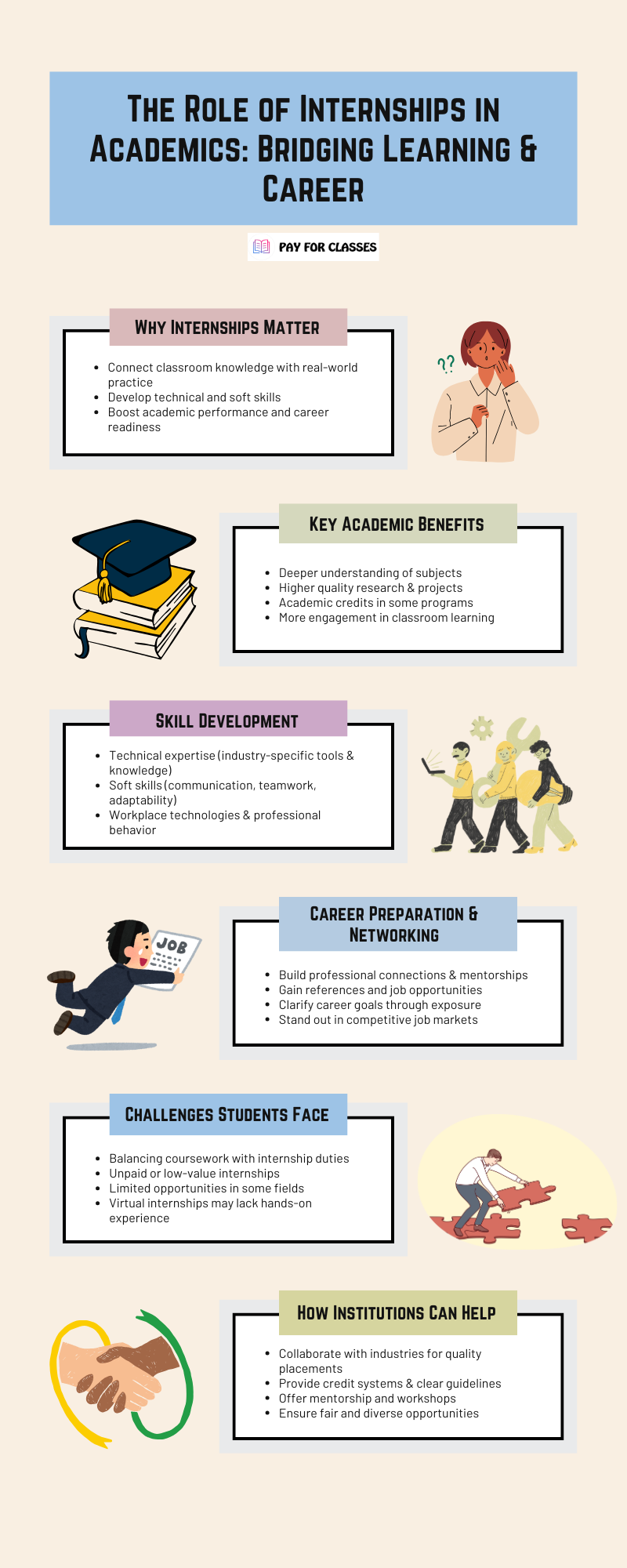
Internships are a key factor in a student’s skill development beyond classroom learning. Academic courses have their place in providing the theoretical foundations and concepts, but internships lead to the development of technical and soft skills and capabilities.
- An internship in Engineering can teach an intern to utilise industry-specific tools, while one in marketing might expose students to actual campaign creation and analytics. Such experiences also provide technical skills relevant to employment.
- The soft skills picked up from the internships are just as important. The real world never stops testing your ability to communicate, collaborate with others, manage your time and devise solutions to problems. These competencies are applicable in any type of program and provide students with a significant advantage once they proceed on to other academic projects and ultimately enter into their profession.
- Through internships, students are also getting introduced to workplace technologies and digital platforms, which are not included in their academic syllabus. Getting used to these types of tools and overcoming that initial fear of using them will make you more confident and adaptable.
So, we can say that the role of internship in academics is very big, because having experience is of great value towards future employers. And at the end of their internships, students don’t just know what to do with this theoretical stuff; they also have a backpack that helps them hack through the job market.
Academic Benefits of Internships
There are many academic benefits provided by internships. In this section, we will study the major role of internships in academics that helps in shaping students for their careers.
- Through this type of real-world project work, students learn to appreciate the relationships between theory and practice.
- For instance, it makes it easier for a business student who is interning in a finance department to see the relevance of accounting, as well as for a biology student who is interning in a laboratory to make sense of what they learned in their textbook when they run an experiment.
- Practical application of academic knowledge, in turn, reinforces the focus on academics by making them more concrete for students and therefore more memorable.
- Internships also help with more sophisticated thinking and problem-solving. When actual systems are given to students, students are forced to think about what to do, considering a situation, weighing different options offered to them, and finally making a decision. Moreover, all these factors contribute to securing higher grades.
- These experiences often lead to higher-quality research projects, papers and presentations, as students have an experiential background to draw upon in their studies.
- Some institutes allow students internships for academic credits, while others take into account your report of internship report for final marking.
- Students seem more engaged and more communicative as they return to the classroom after an internship where they apply theory to the real world.
Also read: Emerging Trends in Educational Administration: What to Expect in 2025 and Beyond
Career Preparation and Networking
Internships are a vital part of career preparation during school. They provide opportunities to gain work experience and to learn job skills, and to meet mentors who can affect career pathways. It would also, with the help of professionals, allow students to see and learn the standards and the how-tos in the industry and build their confidence that they might eventually succeed at a real job.
Additionally, it’s worth networking for internships. Building rapport with colleagues, bosses and people in your field could lead to references, job positions or someone to mentor you for years to come. Getting involved in projects and attending team meetings can really show a student off and help to grow their professional networks.
Juggling internships with academic duties is already difficult to accomplish as it is, especially for students who are taking more than one online class, like mathematics, algebra, etc. In such a case, sharing your requirements, like, I want to hire an expert to take my online algebra class for me, with academic help services can keep you on track so that you can concentrate on internships. If students can successfully integrate academic and practical experiences, they can optimise their skill development and enhance their career readiness.
Challenges and Limitations of Internships
Although the role of internships in academics is crucial and they have several benefits, they have some limitations as well.
- One of the common problems is maintaining the academic side along with work requirements. A lot of internships are quite intensive in time requirements and do not necessarily accommodate courses, exams or online lessons. Hence, you really need to be good at managing your time.
- Another obstacle is what sort of internships are available and how relevant the learning experiences are. Some internships are no more than busy work, with an intern’s hours spent on mind-numbing or irrelevant work. This can stymie growth and diminish the rest of your experience.
- Money is, of course, a factor as well. Unpaid internships, prevalent in a few industries, is a financial challenge for students who want to earn an income to cover their schooling and living expenses.
- In addition, virtual internships could be less hands-on and have less mentorship and less network exposure than being in person. Learners could run into the logistical and communicative barriers related to internships, maybe because there is no strong advising. But there are strategies to overcome these fears, such as being proactive, seeking input and choosing internships carefully.
With a bit of strategy and healthy scepticism, there’s a lot we can take away from internships to jump-start the next level of career preparation.
How Institutions Can Enhance Internship Programs?
Institutions have a key role to play in ensuring that the benefits of internships for students are capitalised. One way to do that is to establish strong industry ties and create internships that are both genuine and well-structured, as well as focused on learning. Clear learning objectives and accreditation schemes can help students know what they are being asked and what academic value is attached to the work.
Mentorship and support are as important as ever. Institutions can designate a faculty advisor to advise the students in difficult times, to reflect upon the learning outcome and provide feedback for enhancement. Today, career expos held in schools offer students the opportunity to learn how to dress appropriately for the workplace, write resumes and network in a professional setting.
To conclude, there must be equal opportunities. Schools can also offer different formats of internships (paid, virtual, part-time) to meet a wide array of student needs and situations. These initiatives are making internships widely available, meaningful and transformative in connecting education to employment.
Conclusion
Internships are one of the important aspects in an academic career that provide students with a chance to apply their theoretical knowledge in practice. They also prepare students for careers through experiential learning and access to professional networks, apart from imparting technical and soft skills. While times can be tough, with courses to juggle and good opportunities scarce, thoughtful planning and backing from an institution can produce outstanding internships. Internships also serve as a link between theory and practice and serve to strengthen educational inputs and preparedness for careers. For the students who truly grab them, the role of internships in academics is invaluable in their personal development and career success.
Frequently Asked Questions
Question: What is the role of internships in academics?
Answer: Internships provide the opportunity for students to bridge the gap between the classroom and the workplace, practice what they have learned and gain practical experience that can help them realise their potential for future learning and work.
Question: What are the academic benefits of student internships?
Answer: Internships develop knowledge of theories and methods learned through education and apply those in a professional setting.
Question: Do internships make students more ready for careers?
Answer: Yes, internships expose students to a professional work environment, mentoring, networking and the real-life skills that make them more employable.
Question: What are the difficulties that students encounter in internships?
Answer: Major challenges are planning coursework, searching for opportunities that pertain to interest and passion, time management, and unpaid or virtual internships.